
Artículo: Which Stone Goes With My House? Matching Natural Stone to Your Roof, Brick and Trim
Which Stone Goes With My House? Matching Natural Stone to Your Roof, Brick and Trim
Design guide · Updated October 2026
Stone is the one thing on your house you'll never repaint. Siding gets replaced, trim gets a new colour, the front door changes every ten years. The stone stays for the life of the house. So it's worth an hour of thinking before you pick it.
Here's how we help people choose, plus eight house styles and the stone that suits each one. Every photo is the actual stone we sell, on a real house.
Six rules before you look at a single stone
Eight houses, eight stones
1. The red brick house

Elite Blue Granite Random, Tumbled, from $12.62 per sq ft.
Red brick is warm and busy. Fighting it with another warm, busy stone turns the front of the house into mush. Go the other way: a cool blue-grey granite gives the brick something to push against, and the random shapes read as old-world masonry next to the straight brick courses. Let the brick wrap the windows and run the stone on the big flat walls, like this.
Why it works: Cool stone, warm brick. Contrast on purpose.
2. The modern farmhouse

White Sandstone Squares & Recs, from $17.88 per sq ft.
White siding, black windows, a steel roof. The worst thing you can do here is add a muddy multi-colour stone. Keep it pale and keep it tailored: squared, light sandstone in tight courses looks like it belongs with board-and-batten and black trim, and it makes the black windows pop even harder.
Why it works: Same light value as the siding, different texture.
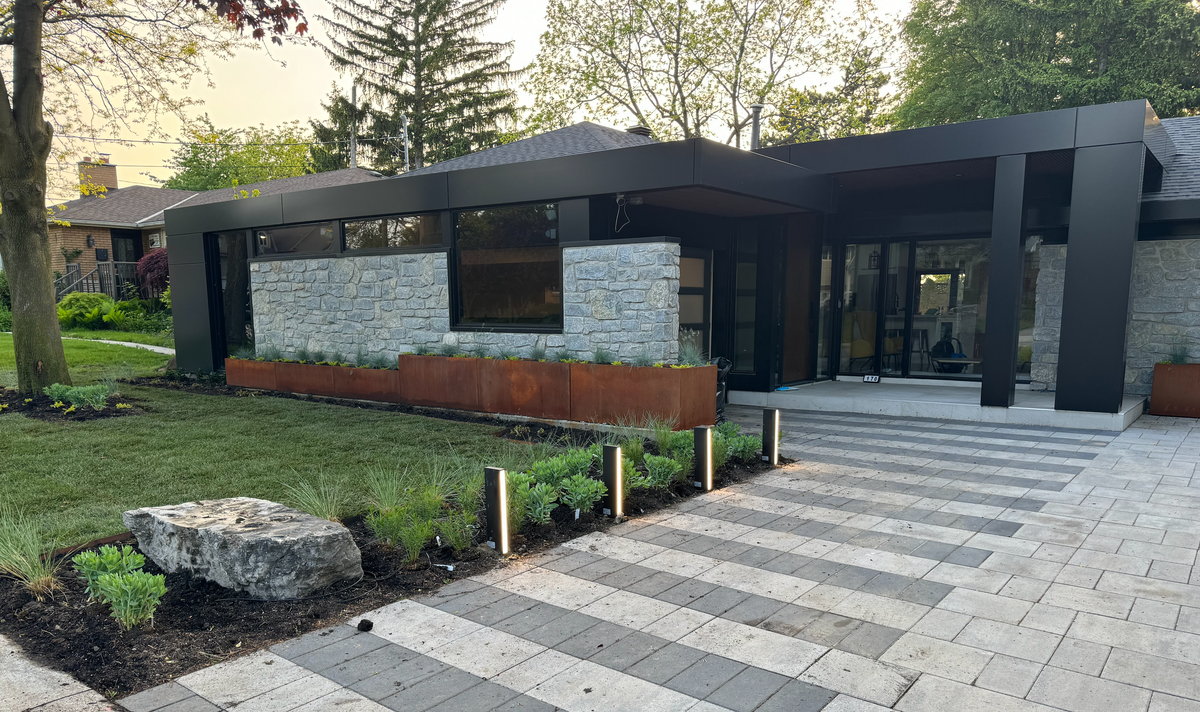
3. The modern glass box

Weatheredge Limestone Ledgerock, from $9.99 per sq ft.
Big glass, dark frames, flat or shed roofs. Modern houses want long, thin horizontal lines that echo the roofline. Ledgerock does exactly that. A soft grey limestone keeps it calm, so the architecture does the talking.
Why it works: Horizontal lines echo a long, low roof.
4. The old-world estate

Earth Tone Sandstone, Jarvis Sawn Height Drystack, from $18.40 per sq ft.
Turrets, steep roofs, arched doors. This is where you go all-in on stone: wall-to-wall, warm earth tones, varied heights. A sandstone blend with browns, tans and a touch of grey reads like it was quarried on the property a hundred years ago.
Why it works: Warm, varied and used everywhere, not as an accent.
5. The mountain lodge

Bear Ridge Estate Ledgerock Blend, from $14.60 per sq ft.
Timber, big views, dark window frames. Lodge houses need stone with weight and some colour range, greys and tans and a little rust, because the wood next to it is already warm. Put it where it carries load visually: columns, chimneys and the lower walls.
Why it works: Stone where it looks like it's holding the house up.
6. The craftsman & cottage

Earth Tone Sandstone, Old Durham Moss & Leiken, from $22.09 per sq ft.
Gables, timber brackets, arched windows. Craftsman houses love rugged, irregular stone with real character, the kind where every piece looks different. This blend has rust, moss-brown and charcoal in it, and it holds its own next to dark siding and wood trim.
Why it works: Irregular, characterful stone beside clean trim.
7. The grand estate

Elite Blue Granite Squared, from $11.56 per sq ft.
Slate-grey roof, formal symmetry, a big driveway. A cool, squared granite in a single colour family looks expensive because it's consistent. It's the stone equivalent of a navy suit. Pair it with a dark roof and crisp white or black trim.
Why it works: One colour family, squared shapes, formal lines.
8. The warm traditional

Harvest Gold Limestone Olde Mill Blend, from $12.62 per sq ft.
Brown or tan roof, cream or beige siding, wood doors. Golden limestone is the warmest stone we sell, and it glows in late-day sun. It's the right call when everything else on the house already leans warm.
Why it works: Warm on warm, all the way through.
Thin veneer or full bed? It doesn't change the look
Every stone above comes as thin veneer (about 1 inch thick, roughly 12 lbs per square foot) and many also come as full bed building stone (3 to 5 inches thick). From the street they look identical. The difference is weight, what the wall needs behind it, and freight. If you're working on an existing house, thin veneer is usually the way to go. Our guide to thin veneer vs. full-bed stone walks through the math.
Before you order
- Take a photo of your house in daylight and send it to us with the stone you're considering. We'll tell you honestly if we think it works.
- Measure once, order once. Use our guide on how much stone you need so the whole job comes from the same run.
- Think about the mortar colour now, not on install day. Ask your mason for a small test panel.
Want to see more? Browse all our thin veneer, or read 7 Different Types of Natural Stone and Choosing Between Stone and Brick.
Not sure which stone suits your house? Send us a photo. Call us, let's talk stone.
(289) 809-6762
Dejar un comentario
Este sitio está protegido por hCaptcha y se aplican la Política de privacidad de hCaptcha y los Términos del servicio.