
Artículo: Thin Veneer vs. Full-Bed Stone: The Real Cost Comparison
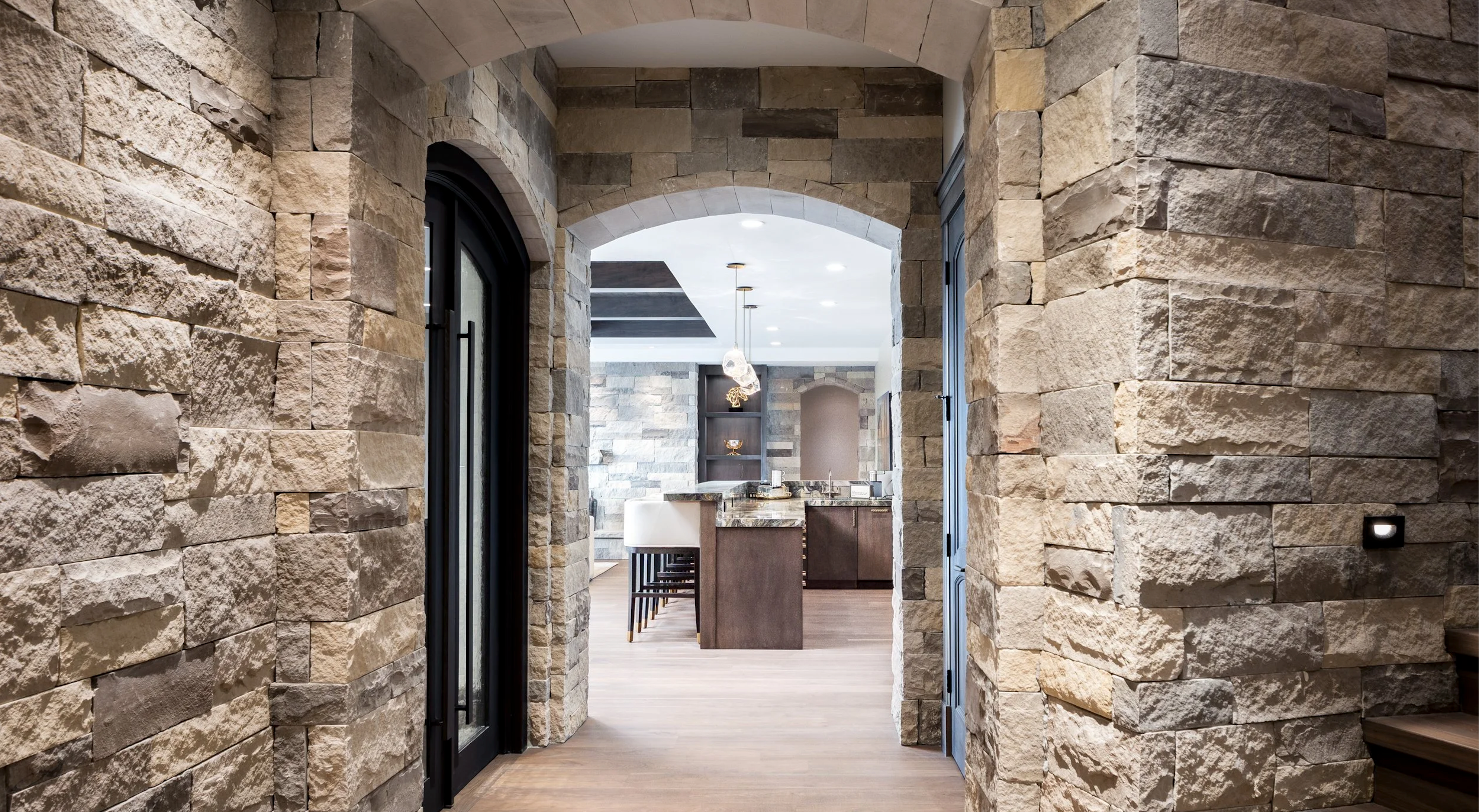
Thin Veneer vs. Full-Bed Stone: The Real Cost Comparison
The Mason's Bench — Buying Guides
Same quarry. Same stone. Two completely different structural systems — and a price gap that has almost nothing to do with the price per square foot on the tag. Here's the comparison suppliers gloss over, from a specialist who sells both and has no reason to steer you either way.
This is the first fork in every natural stone project, and most buyers reach it armed with the wrong number. They compare material prices — where full-bed and thin veneer often look surprisingly close — and conclude the choice is aesthetic. It isn't. The real cost of full-bed stone lives in the structure that carries it, and the real value of thin veneer lives in the structure it doesn't need. What follows is the whole invoice, not just the stone line.
Full-bed carries its weight to the ground through a footing and ties; adhered veneer hangs on its mortar bond. The footing is the invoice line most comparisons forget.
Two Systems, One Stone
Full-bed is stone 3 to 5 inches thick at approximately 50 pounds per square foot, resting on a concrete footing or steel shelf angle and tied back to the structure — a wall in its own right, carrying its own weight to the ground. Thin veneer is the same stone sawn to roughly an inch and a quarter, under 15 pounds per square foot, held to the wall entirely by its mortar bond — no footing, no ledge, no ties. Visually, installed by someone who knows the corner-unit trick, the two are indistinguishable. Structurally, they live in different worlds.
The Whole Invoice
| Cost Line | Full-Bed | Thin Veneer |
|---|---|---|
| Stone (material) | $18–$40 / sq ft equivalent — sold by the ton, ~40 sq ft/ton planning coverage | $14–$45 / sq ft by blend tier |
| Footing / shelf angle | Required — $1,500–$10,000+ per project if not already built | None |
| Engineering / structural review | Often required on retrofits | Rarely |
| Wall ties, air space, flashing system | Required | WRB/lath assembly on framed walls only; nothing extra on masonry |
| Labour | Highest in the masonry trade — heavy units, slow coursing | Roughly half to two-thirds of full-bed labour |
| Freight | ~3–4× the weight per covered sq ft | A crate covers 150–200 sq ft |
| Feasible on framed walls / upper storeys / interiors | Rarely, without major structure | Yes — its whole reason to exist |
Read that middle column honestly and the pattern is clear: on a wall that already has a footing or brick ledge waiting — typically new construction that planned for stone, or a home built with a masonry ledge — full-bed's premium shrinks to material weight, freight, and labour. On a wall that doesn't, the footing line alone can exceed the entire stone budget, which is why "full-bed on a renovated frame wall" quotes produce the sticker shock this industry is famous for. Thin veneer wasn't invented as a cheaper imitation; it was invented to put real stone on the 90 percent of walls that were never built to carry it.
When Full-Bed Is Worth Every Dollar
- The support already exists. New builds designed for stone, or homes with an unused brick ledge. If the expensive part is free, take the heirloom.
- Ground-contact and landscape walls. Retaining walls, garden walls, pillars and piers that live in the splash zone — mass masonry is in its element where adhered systems need careful clearances.
- Horizontal duty. Sills, caps, hearths, steps, and copings want thick sawn stock, full stop. (Most of our thin veneer projects still include full-bed-class caps and sills for exactly this reason — the two formats are teammates, not rivals.)
- Heritage and legacy work. Matching a century wall, or building the one your grandchildren repoint. Mass has a presence that even perfect veneer can't fake at an open door jamb or window reveal — the one place depth shows.
When Thin Veneer Is Simply the Right Answer
- Any retrofit on framed walls — which is most Canadian renovation work. No footing means the project exists at all.
- Over existing brick or block. Direct adhesion to sound masonry is fast, lean, and permanent.
- Interiors and upper storeys. Fireplaces, feature walls, gables, chimney chases — anywhere weight and support rule mass masonry out.
- Budget walls that still have to be real. Half to two-thirds of the installed cost, identical stone face, and the savings buy you the better blend — the trade nobody regrets.
The premium move on a thin veneer project: spend a fraction of the money saved on full-bed sills, caps, and hearths in the matching stone. Depth at the horizontals is where the eye checks whether a wall is "real," and thick stock at those lines makes the whole elevation read as mass masonry — because at every line that matters, it is.
The Five-Question Decision
- Is there a footing or ledge? No → thin veneer, and the decision is over for most projects.
- Is the wall framed, interior, or above the first storey? Yes → thin veneer.
- Is it ground-contact landscape masonry? Yes → full-bed.
- Is it a sill, cap, hearth, or step? Yes → thick stock, whatever the walls are.
- Support exists and budget allows either? Now — and only now — it's a taste and legacy question, and there's no wrong answer at this table.
Quick Answers
Does thin veneer last as long as full-bed?
The stone is identical and effectively permanent either way. A properly detailed adhered system — full mortar coverage, drainage, clearances — is a multi-generation wall; the failure stories you've heard trace to installation shortcuts, not to the format. Full-bed is more forgiving of a mediocre installer; thin veneer done right concedes nothing.
Can I mix them on one project?
It's the professional default: thin veneer on the walls, full-bed stock at sills, caps, hearths, and any ground-contact masonry — one blend across both formats so nothing announces the seam. We supply the Weatheredge family and our other blends this way constantly; ask and we'll spec the split for your drawings.
Is thin veneer "fake"?
It's sawn from the same quarry block as the full-bed pallet beside it. Fake is concrete cast to imitate stone; thin veneer is stone, cut smart. The distinction matters — and it's the entire reason this comparison is between two right answers.
Dejar un comentario
Este sitio está protegido por hCaptcha y se aplican la Política de privacidad de hCaptcha y los Términos del servicio.