
First Question: Veneer or Full-Bed?
Everything else in mortar selection flows from this fork. The two installation methods put completely different demands on the mix — and the single most common mortar mistake we see is using the right product for the wrong method.
Full-Bed Masonry
Full-dimension brick and stone, laid course on course, carrying its own weight down to a footing or brick ledge.
What the mortar does: beds each unit, bonds the courses, and seals the joints. Compressive behaviour matters most.
Your tool: conventional Type N or S mortar, chosen by exposure and unit hardness (table below).
Adhered Veneer
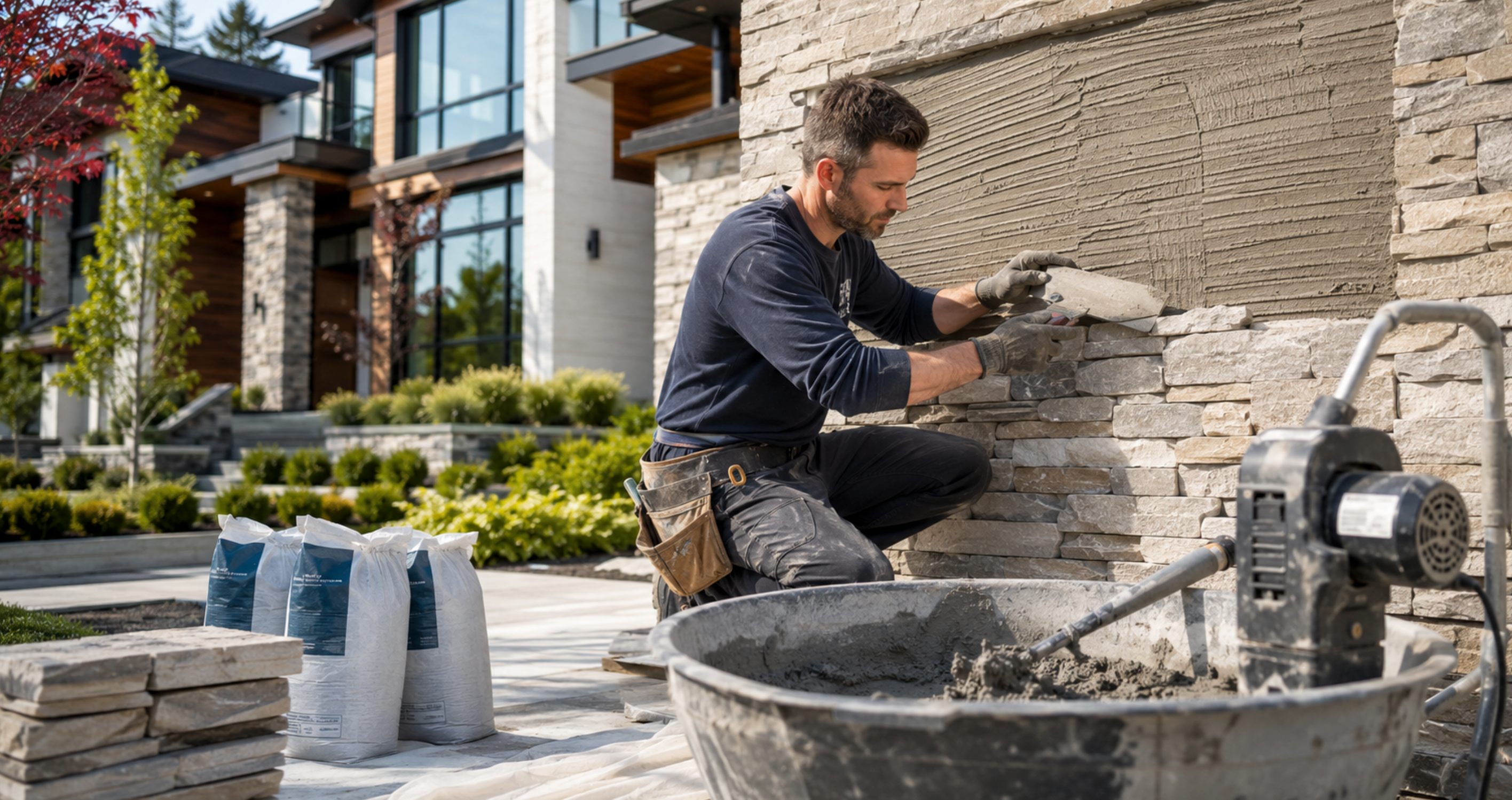
Thin brick or stone veneer bonded to a backing wall over lath and scratch coat — no footing, no self-support.
What the mortar does: everything. The bond is the structure. Adhesion and flexibility matter most.
Your tool: a polymer-modified veneer mortar — not a bag of Type S. More on this below.
The Golden Rule: Mortar Should Be Weaker Than the Unit
This surprises everyone. Intuition says stronger is better, so people reach for the highest-strength bag on the shelf. Masons know better:
Mortar is the sacrificial element. Something has to give — and you want it to be the joint, not the brick or stone.
Buildings move — freeze-thaw, settling, thermal expansion. A too-strong mortar transfers that stress into the brick or stone face, and the unit cracks or spalls instead. Repointing a joint is cheap; replacing masonry is not. This is exactly why heritage brick repointed with hard modern Portland mortar sheds its faces within a few winters — the old soft brick loses the argument with the new hard joint every time.
Full-Bed Work: Know Your Letters
For full-bed brick and stone, standard mortars are graded by compressive strength. The memory trick: every other letter of MaSoNwOrk, strongest to weakest.
| TYPE | STRENGTH | WHERE IT BELONGS |
|---|---|---|
| M | ~2,500 psi | Below grade, heavy loads, foundations. Rarely needed residentially. |
| S | ~1,800 psi | Below grade + anything horizontal or ground-contact: retaining walls, coping, steps, planters. The Canadian workhorse. |
| N | ~750 psi | Above-grade vertical work: brick walls, stone veneer walls, chimneys, softer units. The default for most residential brick. |
| O | ~350 psi | Interior, restoration, very soft historic brick and stone. |
The mason's shortcut for our climate: if water can sit on it or soil touches it, use Type S. For above-grade brick and stone walls, Type N is usually the smarter, more flexible choice — and it's kinder to softer clay brick, limestone, and sandstone.
One brick-specific secret: brick varies enormously in how fast it sucks water out of fresh mortar (masons call this the initial rate of absorption). A thirsty brick drinks the mix dry before it can cure, killing the bond. High-absorption brick gets pre-wetted before laying; dense, low-absorption brick gets laid dry. Your mason should know which one you've bought — if they don't ask, that's a flag.
The Three-Way Balance: Strength, Flexibility, Permeability
These three properties trade off against each other, and the lever is the cement-to-lime ratio:
More Cement
Stronger, stiffer, denser. Good for load — bad at accommodating movement, and it traps moisture inside the wall.
More Lime
Softer, more flexible, more vapor-open. Lime mortar breathes — moisture escapes through the joint instead of through the unit. It even self-heals hairline cracks.
This is why old-world lime-mortar walls outlast many modern ones: in freeze-thaw country, a dense cement joint forces trapped water to exit through the brick or stone face, and the masonry pays the price every winter. If you've seen spalled brick or flaking stone on a repointed heritage wall, odds are someone used hard Portland mortar on soft masonry.
Veneer: Where the Bond Is Everything
Adhered veneer has no footing and no gravity working for it — the mortar bond is the only thing holding your stone or thin brick on the wall. That's why the industry has moved to polymer-modified veneer mortars (look for ANSI A118.15 / A118.4 ratings) and dedicated masonry veneer installation systems. The polymer adds bond strength and flexibility that bagged Type S simply doesn't have — and for exterior veneer riding out a Canadian freeze-thaw cycle, that bond is everything.
King MasonBond 400
In Canada, the go-to is King MasonBond 400 (Sika Canada): a factory pre-blended polymer mortar built specifically for stone and brick veneer, cultured stone, and granite pavers and slabs. It delivers high bond strength, excellent workability, and — critically for our winters — strong resistance to de-icing salts. It comes in grey but can be coloured on-site with King's Colour-Plus pigment system.
One trade note: MasonBond 400 is a setting mortar — it's what bonds the veneer to the wall. For pointing your joints afterward, a standard Type N or S is usually the better tool. Set with the polymer, point with the conventional.
Elsewhere, Laticrete's MVIS line and Mapei's veneer mortars are the systems we see specified most; TEC and Custom Building Products also compete here.
Brands: What's on the Shelf in Canada and the US
King (Sika)
The Canadian mason's default. Consistent, engineered pre-blends, excellent cold-climate formulations, and the maker of MasonBond 400 for veneer work. Slight premium, worth it.
Spec Mix
Contractor favourite in both countries; silo delivery available for big jobs, extremely consistent batch-to-batch.
Quikrete / Sakrete
Widely available, fine for general Type N/S work. Watch batch consistency on colour-sensitive brickwork.
Bomix / TCC
Solid Canadian value options at building supply yards.
Laticrete / Mapei
The specialists for veneer systems and polymer-modified products.
The Real Rule
Consistency matters more than brand loyalty: buy all your bags from one lot, and mix with measured water every time.
Colour: The Detail That Makes or Breaks the Look
Mortar is 15–20% of the visible wall surface — and on brick, the joint colour changes the entire read of the wall. The same red brick looks traditional with grey joints, crisp and modern with charcoal, and soft and historic with buff. Choose the joint colour as deliberately as you choose the brick.
Pre-coloured mortars (King and Spec Mix offer wide ranges) beat site-added pigment for consistency — and keep pigment under ~10% of cement weight or you weaken the mix. Two rules masons live by: same water quantity every batch (wet mixes cure lighter) and tool joints at the same firmness every time.
Cost Perspective
A bag of premium engineered mortar costs maybe $5–8 more than the bargain option. On a typical project, that's a rounding error against your brick, stone, and labour — and it's the one component you can't swap out later without a chisel. This is the last place to save money.
The Bottom Line
- Veneer or full-bed decides everything. Full-bed takes conventional Type N/S; adhered veneer demands a polymer-modified veneer mortar.
- Match the mortar to the unit, not your instincts — weaker and more breathable usually wins.
- Type S for horizontal and ground contact, Type N for above-grade walls.
- In freeze-thaw climates, permeability is protection. Let the joint do the breathing.
- Buy consistent, buy coloured, buy once.
Leave a comment
This site is protected by hCaptcha and the hCaptcha Privacy Policy and Terms of Service apply.